Discover your ROI with ServiceTitan: Calculate Now
Use our free CFM calculator to measure proper ventilation with precision.
Room length (ft.)
Room width (ft.)
Room height (ft.)
Air changes per hour (ACH)
 Add tool to your websiteAdd tool to your website

An HVAC CFM Calculator can help you determine the required airflow rate for every room in your home or business based on a cubic feet per minute measurement of volume flow and the number of air changes per hour, or ACH, needed for proper ventilation.
Use our ServiceTitan CFM Calculator for HVAC to calculate the proper airflow rate for every room.
Follow these easy steps to use our Free CFM Calculator for HVAC professionals. Similar to our HVAC duct calculator and load calculator, the tool is easy to use; you simply need to enter some basic room dimensions.
Enter the room length in feet.
Enter the room width in feet.
Enter the ceiling height in feet.
Enter the room’s desired ACH. (4-8 is recommended for most rooms)
Click the “Submit” button to see your CFM reading.
Next, let’s dive deeper into how to calculate each component of the CFM equation.
Calculating the CFM of a room involves some basic measurements and using the CFM formula. Follow this step-by-step guide to calculate the required CFM for a residential home or commercial property.
The first step involves measuring the length, width, and ceiling height of the room. For standard rooms, a simple tape measure should work. For larger rooms, consider using a laser tape measure.
Next, calculate the room’s volume by multiplying the room width, length, and ceiling height. (Room Length x Room Width x Room Height = Room Volume)
Put simply, air changes per hour (ACH) means the number of times the total amount of air volume in a room is entirely removed and replaced per hour. It directly affects indoor air quality by removing dust and other particles. Rooms with a sufficient ACH reduce the need for air purifiers, exhaust fans, air filtration, or ventilation systems.
Room Air Change Per Hour Requirements
To calculate the precise air changes per hour of a room, you need to know the room’s CFM measurement. Since you may not know the ACH of the room, you can try an online air changes per hour calculator or use one of the suggested ACH measurements below.
Closet: 3-4
Bedroom: 5–6
Living room: 6–8
Kitchen: 7–8
Bathroom: 7–8
Laundry room: 8–9
Attic: (with air conditioning) 12-15
After choosing the ACH, you now have all of the necessary CFM requirements. In the next section, we’ll walk you through the formula.
Use the formula below to calculate CFM:
CFM = (Room Volume in cubic feet) x (ACH) / 60
To recap, you can calculate the room volume in cubic feet by multiplying the room’s length, width, and ceiling height. Since you likely don’t already know the exact ACH, use one of the suggested ACH measurements listed in the section above.
After multiplying the room volume by the ACH, simply divide the total by 60 to get the CFM.
Next, let’s walk through each step of calculating the CFM of a room. For this example, we’ll calculate the CFM of a living room with the following specifications:
Room length: 12 ft.
Room width: 14 ft.
Ceiling height: 10 ft.
ACH: 6
CFM of a living room example:
Calculate the room size in square feet: 12 x 14 = 168 square feet
Calculate the room volume by multiplying square feet by room height: 168 x 10 = 1,680 cubic feet
Multiply the room volume by the ACH: 1,680 x 6 = 10,080
Divide the total by 60 to get the CFM: 10,080 / 60 = 168 CFM
How Many CFM Are Required in a Room?
Regular air exchange is critical for maintaining healthy indoor air quality. Without the regular circulation of fresh air through an HVAC system and ductworks, health risks may increase due to the buildup of mold and other airborne contaminants.
The proper airflow of a room ultimately depends on the room size, number of occupants, and the room’s use. For instance, a closet can have a lower CFM compared to a bedroom or living room where people spend more time.
The American Society of Heating, Refrigerating and Air-Conditioning Engineers (ASHRAE), recommends a minimum CFM rating of 15 per person in residential homes. Consider these recommended amounts from Inch Calculator.
Ensuring proper airflow is just one part of running a successful HVAC business. To help manage more complex tasks like estimating system capacity, scheduling jobs, and tracking performance, using HVAC software can be invaluable. ServiceTitan's HVAC software offers powerful tools to streamline operations, from precise calculations to customer management, ensuring your business runs smoothly.
Use the formula below to calculate CFM:
CFM = (Room Volume in cubic feet) x (ACH) / 60
To recap, you can calculate the room volume in cubic feet by multiplying the room’s length, width, and ceiling height. Since you likely don’t already know the exact ACH, use one of the suggested ACH measurements listed in the section above.
After multiplying the room volume by the ACH, simply divide the total by 60 to get the CFM.
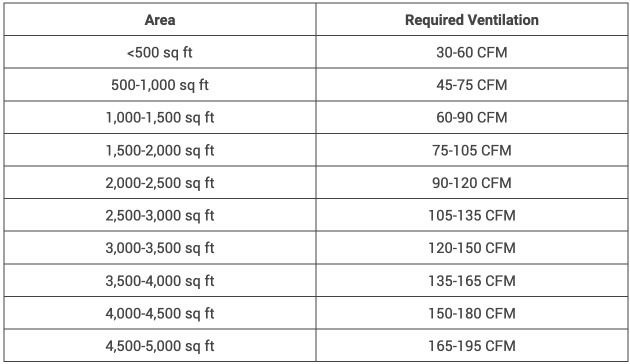
*The recommended CFM and ACH amounts are estimated in good faith and are solely meant for generic, informative purposes. We do not guarantee the accuracy of this information. Please note that other external factors may affect or falsify the recommended CFM and ACH recommendations. For accurate values, consult a licensed HVAC professional.
You want to avoid an excessively high or low CFM. Ideally, it should be calculated depending on the room’s precise specifications. An extremely high CFM will cause a room to feel overly breezy and will prevent air conditioners from removing humidity. A low CFM hampers air circulation and often causes rooms to feel stuffy and hot.
The recommended air change per hour for a room always varies based on several factors, including the type and use of a room, as well as room size and amount of airborne contaminants. Check out this table for ACH recommendations.
CFM (Cubic Feet per Minute) measures the volume of air flowing through a particular room or system per minute. HVAC pros use CFM to determine the amount of air that needs to be moved or exchanged in a given area for ideal ventilation or cooling. ACH (Air Changes per Hour) involves the number of times the total volume of air is replaced in a room per hour. It measures the effectiveness of removing airborne contaminants and controlling indoor air quality.


