The HVAC industry is undergoing its biggest refrigerant transition in decades.
Under the federal AIM Act, signed into law in December 2020, the U.S. is phasing down high-global-warming-potential (GWP) hydrofluorocarbons (HFCs), fundamentally changing which refrigerants can be used in new HVAC equipment.
Now, lower-GWP alternatives such as R-454B and R-32 are replacing R-410A, the industry’s standard refrigerant for more than 20 years.
So what does that mean for HVAC contractors? Will something change?
This guide explains everything, including what the refrigerant mandate requires, how it affects existing HVAC systems, and practical steps HVAC pros should take to remain compliant while preparing for the industry’s transition.
» Want to grow your business? Click here to book a demo.
What Is the Refrigerant Mandate and Why Does It Exist?
The term ‘refrigerant mandate’ is commonly used by contractors when referring to related but distinct documentation:
The American Innovation and Manufacturing (AIM) Act, a law Congress enacted on December 27, 2020.
The U.S. Environmental Protection Agency (EPA) rules that implement the AIM Act.
The AIM Act itself gives EPA the legal authority to phase down the production and consumption of HFCs by 85 percent from historic baseline levels by 2036. HFCs are the refrigerants responsible for significant carbon footprints and greenhouse gas emissions in most HVAC and refrigeration equipment.
The Act sets that target and grants authority in three areas: phasedown to combat climate change, managing HFCs and their substitutes, and facilitating sector-based technology transitions.
However, the Act itself doesn’t spell out equipment-specific compliance deadlines.
That detail comes from separate EPA regulations, most notably the Technology Transitions Rule, which sets specific dates for when manufacturers must stop producing new equipment using high-GWP greenhouse gas refrigerants like R-410A.
This is why compliance dates can shift: EPA can revise its own implementing rules without Congress amending the AIM Act itself.
The #1 newsletter for the trades.
What Is the Difference Between a Phasedown and a Phaseout?
A phasedown, as mentioned in the AIM Act, reduces the production and consumption allowance of HFCs over time, capping it at 15 percent of baseline by 2036.
However, it doesn’t ban the refrigerant itself or the equipment using it. What it limits is the production and import of bulk HFCs through an allowance system.
There is no requirement to stop using any HFC-based equipment currently in service.
A phaseout, by contrast, refers to the earlier, separate program for ozone-depleting HCFCs (hydrochlorofluorocarbons) like R-22, where new production and import were banned outright (R-22 production ended January 1, 2020, under the Montreal Protocol). Existing R-22 equipment could keep running, but no new supply was being made.
Which Refrigerants Are Being Phased Down and What Will Replace Them?
The mandate targets high-GWP HFCs, refrigerants like R-410A, which has a GWP of 2,088. Under the Technology Transitions Rule, new residential and light commercial air conditioning and heat pump systems manufactured or imported after January 1, 2025, must use a refrigerant with a GWP below 700.
Two refrigerants meet that threshold: R-32, with a GWP of 675, and R-454B, a blend with a GWP of 466. Both are classified as A2L, mildly flammable, which requires updated handling procedures, adherence to revised building codes, and technician training.
Manufacturer adoption has split by product line. R-454B has secured support from HVAC manufacturers and suppliers like Carrier, Trane, Lennox, York, and Rheem, making it the dominant choice for residential splits and light commercial equipment in the U.S.
R-32 remains concentrated in mini-split air conditioners and VRF systems, primarily from Daikin and Mitsubishi Electric.
Neither refrigerant is retrofit-compatible with existing R-410A systems. Both require purpose-built equipment, and the two refrigerants cannot be mixed with each other or with R-410A.
How Does the Mandate Affect Existing HVAC Systems?
Existing HVAC systems are unaffected by the mandate. Homeowners and businesses can continue using, repairing, and servicing equipment already installed, including replacing a failed compressor, condensing unit, or other component with a similar R-410A part. The 2023 Technology Transitions Rule does not restrict use of any product or system already installed or in the possession of an end-user.
Components manufactured with R-410A after January 1, 2025, can still be produced and imported, but only for servicing existing equipment and must be labeled ‘for servicing existing equipment only.’ Inventory manufactured or imported before that date doesn’t need to be relabeled.
There’s a distinction between repair versus system replacement. Replacing one component, like just the condensing unit, counts as a repair. Replacing the condensing unit and indoor coil together counts as installing a new system.
Originally, any new system installed after January 1, 2026, needed to use a refrigerant with a GWP below 700. That installation deadline has since been removed: on May 21, 2026, the EPA finalized a rule allowing residential and light commercial AC and heat pump systems manufactured or imported before January 1, 2025, to continue being installed indefinitely.
Financial Impacts for Homeowners and Building Owners
The EPA projects the broader Technology Transitions Rule will save consumers and businesses up to $4.5 billion overall, driven primarily by lower-cost refrigerants and energy efficiency gains in new equipment.
However, those long-term savings come with near-term costs, as contractors and clients adjust to new equipment, refrigerants, and installation needs.
New systems built for A2L refrigerants like R-454B or R-32 typically cost 10-15 percent more than equivalent R-410A systems, largely due to integrated leak sensors, sealed relays, and A2L-rated components. Contractors are passing some of that cost through in labor as well, since installing and servicing A2L equipment requires new recovery machines, detectors, and certification.
For owners keeping existing R-410A systems, the bigger cost pressure is on the refrigerant itself. As production allowances shrink under the AIM Act’s phasedown schedule, R-410A has become pricier to source for repairs. Since wholesale prices have climbed well above pre-2022 levels, service call costs have also risen.
For buildings with aging or leak-prone systems, that makes the timing of a full replacement, rather than continued servicing, an increasingly important financial decision.
What Must HVAC Contractors Do to Prepare for the Transition?
Preparing for the transition means addressing both compliance requirements and day-to-day operational readiness.
On the compliance side, technicians handling A2L refrigerants need updated EPA Section 608 certification with A2L-specific training.
Additionally, any R-410A components manufactured after January 1, 2025, that a contractor stocks or sells for servicing must carry the required ‘for servicing existing equipment only’ label.
Contractors installing new systems also need to correctly determine whether a job counts as a repair or a new system installation, since that distinction determines which GWP rules apply.
Operationally, most shops need to invest in new field tools, namely, spark-proof recovery machines, A2L-rated leak detectors, and left-hand thread adapters, the cost generally running $2,000 to $5,000 per truck.
Inventory management gets more complex too, since contractors now need to track and price both R-410A and A2L components separately, rather than as a single refrigerant line.
Using field service software like ServiceTitan can help manage these operational complexities.
Updating pricebooks to reflect new stock-keeping units and pricing, managing dual-refrigerant inventory across trucks, and dispatching only certified technicians to A2L jobs are all easier to manage on a connected platform than through spreadsheets and separate systems.

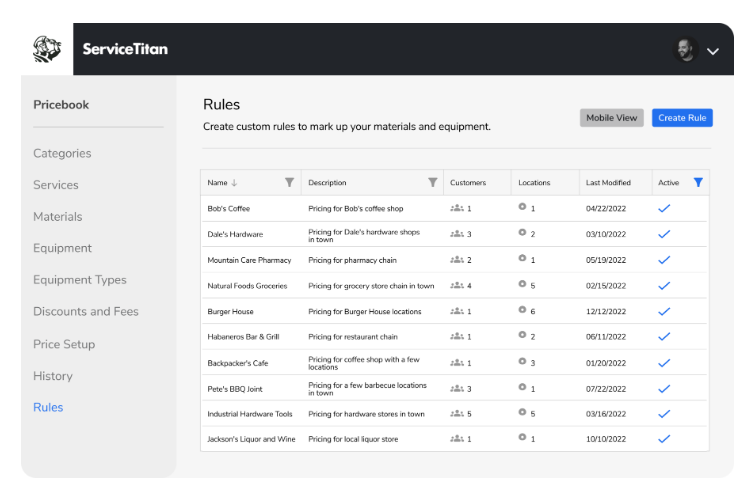
By replacing disconnected spreadsheets and manual workflows with integrated field service management software, ServiceTitan helps businesses stay organized, compliant with new regulations, and efficient throughout the transition.
Over to You!
The refrigerant mandate is an ongoing shift in what contractors can install, service, and stock, with rules that continue to evolve as EPA revises its own implementation timelines.
Staying compliant means tracking which refrigerants apply to which jobs, keeping A2L-certified technicians dispatched correctly, and managing pricing across two refrigerant systems at once.
ServiceTitan helps with exactly that: Pricebook Pro keeps A2L and R-410A pricing organized, inventory management tracks both refrigerant lines across trucks, and dispatch ensures the right certified technician gets the right job.
Get a demo to see how it fits your business.
ServiceTitan helps HVAC contractors manage the operational complexities of the refrigerant transition from a single platform. Contractors can update pricebooks with new pricing and dispatch qualified technicians to A2L jobs based on certifications and skills.


Frequently Asked Questions (FAQs)
What Is R-454B and How Does It Compare to R-410A?
R-454B is a blend refrigerant with a GWP of roughly 466, compared to R-410A’s GWP of 2,088—a 78 percent reduction. It’s classified as A2L, mildly flammable, unlike R-410A’s non-flammable classification.
R-454B has become the dominant replacement among major U.S. manufacturers for new residential and light commercial equipment.
Can Existing R-410A Systems Be Converted to R-454B?
No. R-454B is not a field retrofit for existing R-410A systems. It requires purpose-built equipment designed specifically for its pressure, oil, and safety requirements. When an R-410A refrigerant needs replacing, that means installing new A2L-compatible equipment, not converting the existing unit.
How Much More Do R-454B Systems Cost Compared to R-410A?
New systems built for A2L refrigerants like R-454B typically cost 10-15 percent more than equivalent R-410A systems, mainly due to integrated leak sensors, sealed relays, and A2L-rated components. Contractors also face added tooling costs to service them.
How Can ServiceTitan Help Contractors Navigate the Refrigerant Transition?
ServiceTitan connects the pieces contractors need to manage this shift:
Pricebook Pro keeps A2L and R-410A pricing organized
Inventory management tracks both refrigerant lines across trucks and warehouses
Dispatch ensures certified technicians are matched to A2L jobs automatically
How Should Contractors Manage R-410A Inventory and Sell-Through?
R-410A components manufactured after January 1, 2025, can still be produced and sold, but only for servicing existing equipment and must be labeled ‘for servicing existing equipment only.’ Inventory manufactured before that date doesn’t need relabeling and can be tracked separately from new A2L stock.
ServiceTitan Software
ServiceTitan is a comprehensive software solution built specifically to help service companies streamline their operations, boost revenue, and substantially elevate the trajectory of their business. Our comprehensive, cloud-based platform is used by thousands of electrical, HVAC, plumbing, garage door, and chimney sweep shops across the country—and has increased their revenue by an average of 25% in just their first year with us.